
Wilkes-Barre Previous Residents by Era
Previous residents are best traced with an era check before a name search. Luzerne County's Recorder of Deeds holds the ownership trail, while the library and archival collections preserve listed households and maps. A recorded owner is not automatically an occupant, and a directory listing is not a complete household roster. The useful result comes from putting both forms of evidence in date order, then testing whether the address, parcel, or legal description stays consistent.
| Source | Years it covers | Where held | What it can show |
|---|---|---|---|
| Deeds and mortgages | 1787-present | Recorder, IQS, Landex, Records Facility | Owner-to-owner conveyance and legal-description trail |
| Older grantor/grantee books | 1786-August 1, 1993 | IQS Infodex and bound books | Historic party-index bridge |
| LCHS city directories | 1871-2004 | Bishop Memorial Library | Listed household, home/work address, spouse or occupation |
| Osterhout directories | 1884-present, not comprehensive | Osterhout Free Library | Later directory layer and volume-by-volume leads |
| Census microfilm | 1790-1930, except 1890; public federal releases through 1950 | Osterhout, LCHS, and federal resources | Household snapshot at a census date |
| Ward and Sanborn maps | 1882-1904 wards; 1910-February 1950 Sanborn volume | LCHS and Library of Congress | Street, block, and building continuity |
Use the recorded chain when the question is ownership. Use a street-indexed directory, when the volume has one, to look for a listed household near a transfer date. Census and newspapers help fill the interval between those dates. The 1890 census is absent, so an address trail across that gap needs directories, deeds, maps, or local notices instead.
Wilkes-Barre Deed Records Cross Two Index Eras
The Luzerne County Recorder of Deeds identifies its first recorded document as 1787. Modern access does not replace the older material. Landex Remote covers records from 1968 forward, and its images are indexed from December 1980. The free-index route in Landex Webstore leads to documents that are purchased through its cart. For older work, the county points researchers to IQS E-Film/Infodex, where older deeds and historic grantor/grantee index books form the bridge.
That transition is a Wilkes-Barre house-history quirk. The Recorder says older deeds run through 1967 in IQS, while the bound-book and microfilm preservation period extends through August 1993. Overlap is useful for checking a difficult link. If a needed image is not available remotely, use the Recorder's public terminals, send a precise mailed request with the name and book or page reference, or ask the County Records Facility to pull an older stored file before a visit. Certified Recorder copies are available only in the office.
The Recorder's Record Alert is a separate, free monitoring service for up to five names or PINs. It sends a notice after a matching recording, but it does not prevent recording and is not a title guarantee.
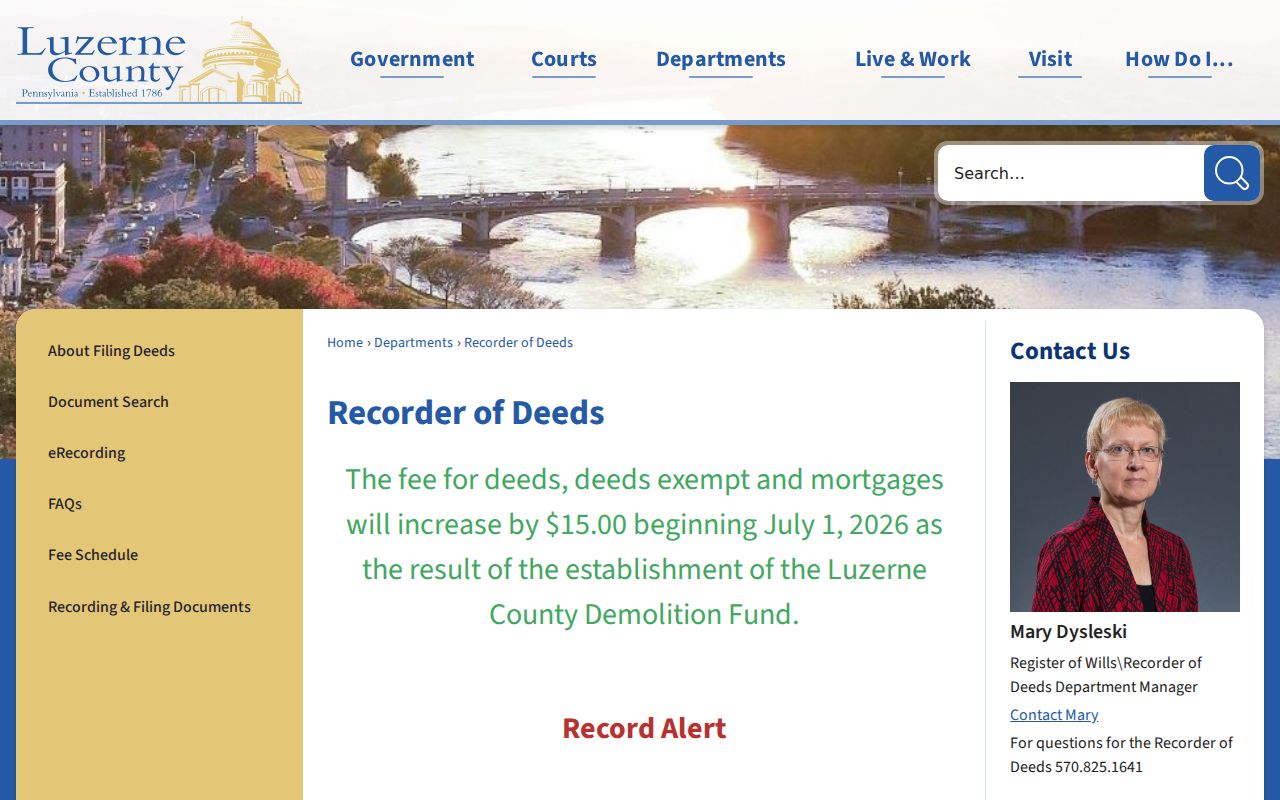
The alert is useful for reviewing a new property-record event promptly. It does not establish who lived at the address or resolve an older deed chain.
Trace Wilkes-Barre Previous Residents Through Deeds
Start the backward trail with the parcel, not just the street number. The county GIS and Assessment Office connect the current address to a PIN, or parcel identifier. A deed is party-indexed, so the address alone may not return the right document. The recorded legal description and the PIN are steadier links when a lot was split, a number changed, or several properties share similar street names.
- Find the current address, municipality, PIN, and owner of record through the county GIS or the Assessment Office.
- Search that owner as the grantee in Landex for the modern purchase record, then note its recording date, grantor, book/page or instrument number, and legal description.
- Read the deed's prior-reference or “Being” recital when present. It can point to the earlier book/page, prior owner, execution date, or recording date.
- Search the earlier party as grantee, match the legal description or parcel details, and repeat rather than relying on a surname alone.
- Move to IQS, Recorder terminals, microfilm, or the Records Facility when the chain reaches the older access period.
- Grantor and grantee
- A grantor transfers an interest in a recorded conveyance. A grantee receives it. The roles point in opposite directions through the index.
- Chain of title
- A dated sequence of recorded conveyances connected by the same property description. It tracks transactions, not continuous residence.
- Legal description
- The deed's parcel or lot description. It can join an old document to a modern PIN more safely than a street address.
Estate, trust, foreclosure, business, and multiple-parcel transfers can interrupt a simple one-person sequence. Stop when the legal description changes and reconcile the lot, plat, or PIN before carrying a name backward. Note: A deed dates a transaction, not every move into or out of a Wilkes-Barre home.
Wilkes-Barre PINs Bridge Older Addresses
Luzerne's GIS uses a fixed PIN made from municipality, map, block, lot, and improvement segments. The official search help asks for a structure number and street name with an abbreviated suffix, permits a partial PIN or street search, and allows map-click selection. Preserve the long PIN exactly when comparing sources. An old directory address is useful, but it is not itself the legal description.
The free GIS advertises parcel PIN, owner, assessed values, streets, structure addresses, and aerial imagery. Its paid tier adds mailing address, deed book/page, and other parcel fields. That is an important distinction: a tax mailing address can belong to an agent, business, estate, or owner elsewhere. It is not proof that the person received mail or lived at the Wilkes-Barre property. The County's GIS/Mapping portals describe both access levels and their different tools.
Wilkes-Barre Past Residents in Directory Years
Directories supply the household layer that deeds cannot. The Luzerne County Historical Society reports Wilkes-Barre directories from 1871 through 2004, with street indexes in some volumes. Osterhout's run begins in 1884 and continues to the present, but the library warns that it is not comprehensive. A missing listing can reflect an omitted volume, an abbreviated entry, a household outside that edition, or a person who was not listed.
- Choose a deed or construction date that narrows the period for the Wilkes-Barre address.
- Check a directory volume near that date, then test adjacent years for an arrival, departure, or changed household name.
- Use a street index only when that volume has one, then verify the listing in its alphabetical section.
- Pair the nearest public census year with directory results to see the household snapshot, remembering the 1890 gap.
- Use newspapers, cemetery facts, or probate records to investigate a disappearance without assuming the reason.
Osterhout's genealogy service can search obituary microfilm when given an exact death date. Its stated route is prepaid and may take three to six weeks. For the directory holdings themselves, the historical collections are examined more fully through the Wilkes-Barre city directory collections.
Wilkes-Barre Maps Date a House Before Names
Maps solve the address-continuity problem without pretending that Wilkes-Barre had one verified citywide renumbering event. LCHS holds ward maps from 1882, 1894, and 1904, as well as a 1933 fire-insurance atlas. The Library of Congress Sanborn volume covers 1910 through February 1950 in 102 sheets. Locate the block in a later map first, then compare an earlier ward or fire map with the parcel and directory evidence.
A Sanborn sheet can show building footprint, use, street, and block context. It does not name previous residents. For an address that has been subdivided or changed form, that restraint matters. Compare the map edition, directory street index, legal description, and present PIN, then make a focused request for planning or records material if the old location still will not bridge cleanly.
Building permits can date work at a property. Wilkes-Barre Building Code Enforcement has a City Hall application route with project address, start/end date, applicant, owner, and contractor areas, but no official public historical permit search was located. A targeted request should name the present and historic address, approximate period, PIN if known, and the record type sought. It is project evidence, not an occupancy list.
Wilkes-Barre Previous Residents at Trail Endpoints
When a household disappears from a directory, county estate material can provide a dated endpoint without proving where anyone lived next. The Register of Wills has estate indexes from 1875 through 2004 in IQS, with broader estate access described by the Register of Wills and Clerk of the Orphans' Court. An estate number can lead to a Records Center pull or a county file request. Use the estate as a family or property clue, then return to the deed and directory dates.
The City Cemetery file is another unusual historical bridge. It can retain applicant residence and occupation, deceased identity, event dates, birthplace, age, cause, and later-removal remarks. Those fields can explain why a person no longer appears in a later directory, but an interment record is not a current-address record. Note: Very early Luzerne trails may lead outside the county because predecessor jurisdictions held the territory before Luzerne County was established.
The IQS Infodex gateway is the visible starting point for older Luzerne index research and county-record access routes.
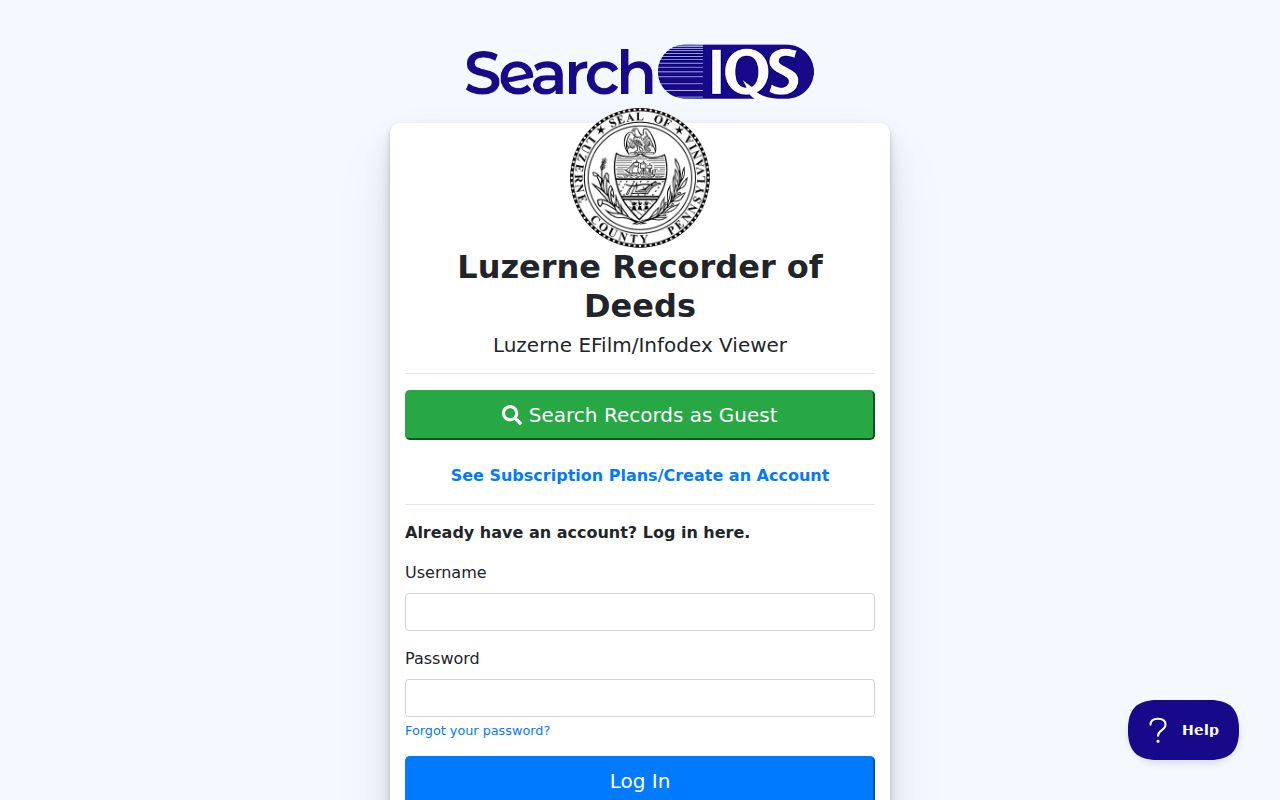
Use the index to identify the relevant dated file, then confirm its contents through the custodian's available copy, counter, or records-center channel.
Respecting Wilkes-Barre House-History Limits
Previous residents research is most useful for family history, estate questions, and the history of a property. It should not turn an old tax address, recorded owner, or directory entry into a claim about a living person. Pennsylvania's Address Confidentiality Program lets eligible survivors use a substitute address in listed government records, including voter and court settings. Missing or redacted information may reflect lawful protection, not an error to work around.
Lawful use. Use Wilkes-Barre house-history records for a respectful, personal purpose. Pennsylvania law prohibits stalking and harassment, and protected address information must not be pursued or exposed.
Keep a source log with the address form, PIN, legal description, document date, map edition, directory year, and access channel. That simple record makes it clear which facts are recorded, which are historical listings, and which still need confirmation from the custodian.